

I have been carrying a Coast headlamp of one kind or another for the better part of a decade, so when the XPH30R showed up I expected more of the same: solid build, sensible beam, nothing flashy. Two seasons later, after a wet spring in the Cascades and a dry summer in the high desert, I can tell you it is more complicated than that. This is the honest version, the one that does not pretend every feature is perfect.
The short version: the Coast XPH30R is a genuinely good headlamp with one design choice that will drive some people crazy. Whether it is the right light for you depends on how you feel about twist focus, how much you trust a USB-C port in the rain, and whether you would rather have a flood beam or a spot beam without having to fiddle.
The Quick Verdict
A tough, bright, well-balanced headlamp that earns its place in a vehicle kit or pack, as long as you are comfortable with twist focus and a charging port that needs a little respect in heavy rain.
Amazon Check Today's Price →The headlamp I keep reaching for on night hikes
After two seasons of field use, the Coast XPH30R is the light I grab first when the trail goes dark. Check today's price on Amazon and see if it fits your kit.
Amazon Check Today's Price on Amazon →How I've Used It
I am Cal Hendricks. I spent 22 years coordinating search and rescue in central Oregon, and I still test gear the way I did then: I use it until something breaks or until I trust it completely. The XPH30R went into my rotation in early spring and has been on my head for trail work, camp setup in the dark, vehicle repairs on the shoulder of Highway 20, and one memorable night of fence mending after a cow got out near the Deschutes.
It also lives in my Toyota 4Runner between trips, which means it has baked in the sun, frozen in the cab, and bounced around in the door pocket for months. That is the test that matters for a lot of people: not whether a light works on a clean desk, but whether it still works when you grab it in a hurry after it has been treated like gear instead of like a display piece.
I kept notes on battery life, beam quality, charging behavior, and every time I wanted to throw it across the yard. That last category matters more than most reviews admit. On May 4, a cold rain moved in while I was re-tensioning a fence line, and the light sat on a post for two hours in a steady drizzle. It never blinked. On July 19, I dropped it from the tailgate onto packed gravel while loading firewood, and it landed lens down. The lens survived, and the only mark was a scuff on the bezel that I cannot even feel with a fingernail.
The Beam: Twist Focus Is a Tradeoff, Not a Free Lunch
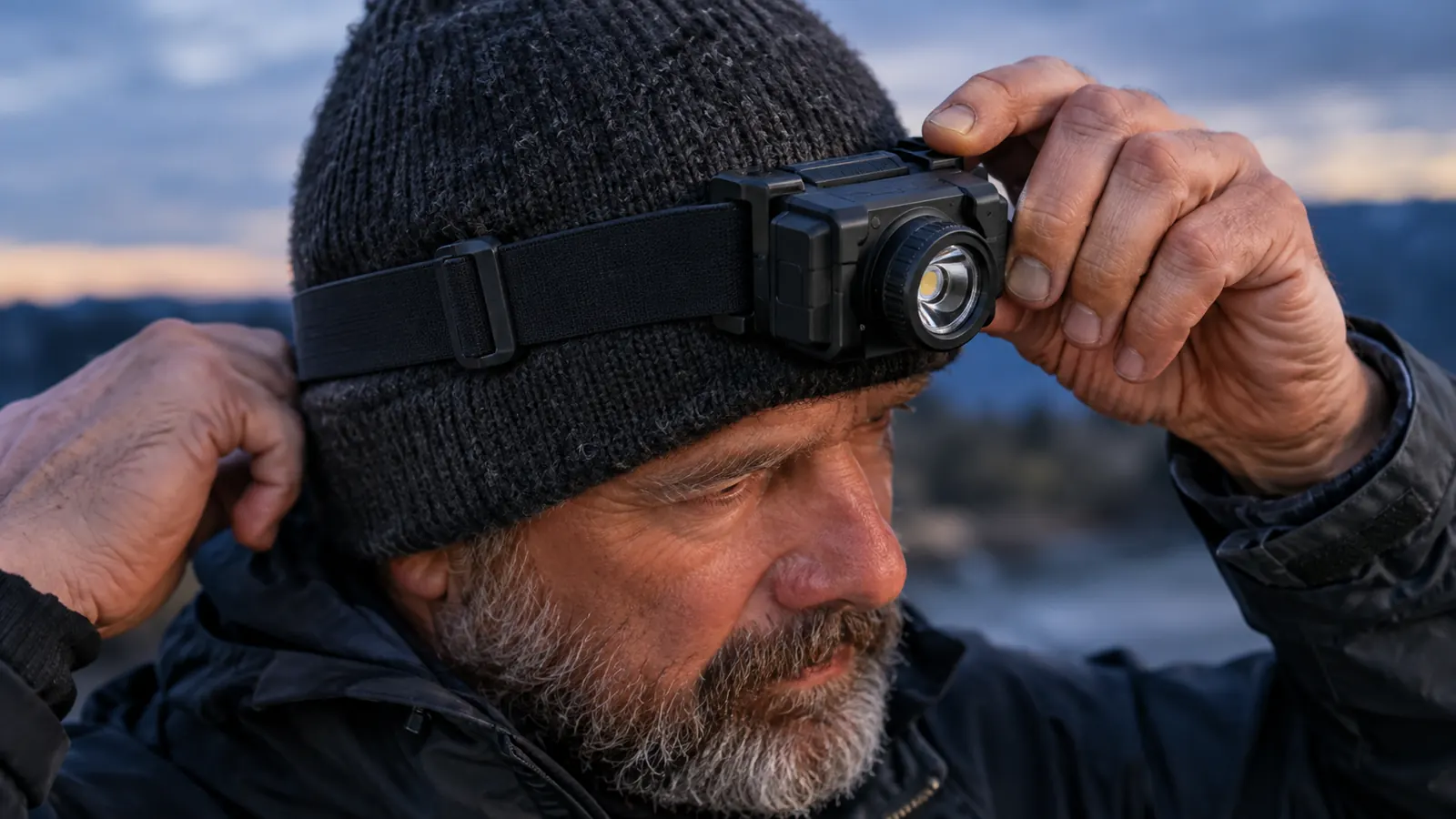
The XPH30R uses Coast's twist focus. You rotate the lens housing to go from a wide flood to a tight spot, and it is genuinely smooth. One hand, a quarter turn, done. I have used it to read a map at arm's length and then, without taking the light off my head, twisted it to throw a beam across a creek to see what was making noise on the far bank. That range of adjustment is the reason this light exists.
But here is what nobody tells you: twist focus means the beam is never perfect at both ends. At the widest setting you get a smooth, even flood that is excellent for camp chores. At the tightest setting you get a usable spot, but it is not a clean, round hotspot like a dedicated reflector gives you. It is more of a bright center with a soft halo. For most tasks that is fine. For scanning a ridgeline or trying to identify something at distance, a dedicated spot beam does it better.
The other thing nobody tells you: the twist ring collects grit. After a summer of dusty trails, mine started to feel slightly gritty when rotated. A rinse under the tap fixed it, but it is worth knowing that the mechanism needs occasional cleaning if you use the light hard. I found this out the hard way in late August after a week of smoke and ash from the seasonal fires. The ring turned stiff and scratchy, and for a moment I thought the mechanism was failing. It was not. Ten seconds of running water, a shake, and it was back to smooth. That is maintenance, not a defect, but it is maintenance you should plan for.
The beam is never perfect at both ends. At the widest setting you get a smooth flood. At the tightest you get a bright center with a soft halo, not a clean spot.
Brightness and Battery: The Numbers That Matter
Coast rates the XPH30R at 1200 lumens on the high setting. That number is real, but it is also a trap if you do not read the fine print. The light hits 1200 lumens only on the highest mode, and it steps down as the battery drains. You get a few minutes of full output, then it settles into a still-very-bright but noticeably lower level. That is how most modern rechargeable lights behave, and the XPH30R is honest about it in the manual. It is worth knowing before you buy, because some reviews make it sound like you get 1200 lumens for the whole battery life. You do not.
What impressed me more than the peak number is the middle ground. The medium setting is the one I actually use for hiking, and it ran for hours without me thinking about the battery. On a typical three-hour night hike with a mix of medium and high, I came home with plenty of charge left. For a full weekend of camp use, I charged it once. On the June 14 overnight at Todd Lake, I ran the light on medium for roughly four hours of evening camp chores and then on low for another two hours while I read. The indicator still showed half a charge the next morning.
The battery is built in, which means you cannot swap in a spare AA when it dies. That is the tradeoff for the light weight and the USB-C charging. For my use, with a power bank in the truck and a charger at home, it is a fair trade. For someone who spends weeks at a time away from power, it might not be. I would also note that the low mode is genuinely low, which is rarer than it should be. It is dim enough to read by in a tent without waking Joanne, and that alone has saved me from a lot of awkward shuffling in the dark.
One more battery note, and it is one that matters if you live somewhere with real winters. On a clear night in late April, when the temperature dropped into the low twenties, the gauge fell faster than it does in July, and the high mode stepped down sooner. The light never quit, but I planned for a shorter run time and charged it before I left the truck. That is not a defect. It is physics. But it is the kind of thing a review that only tests on a desk never mentions.
The Charging Port: My One Real Complaint
Here is the thing that almost made me send this light back. The USB-C port is on the top of the housing, under a rubber flap. The flap seals well when it is fully seated, and I have had no water intrusion in two seasons of use, including one downpour that had me reaching for the light to fix a tarp. But the flap is small, and it is easy to think you have it fully closed when you do not. If you leave it even slightly ajar, the port is exposed.
I have developed a habit of pressing the flap with my thumb every time I pick the light up. That is not something I should have to think about, and it is the one design detail I would change. A recessed port or a more positive latch would fix it. As it is, the light is fine as long as you are disciplined about the flap. I caught it ajar twice in the first month, once after a quick top-up charge in the truck and once after checking the charge level before a hike. Neither time did it see water, but both times it was a reminder that the seal only works when you seat it.
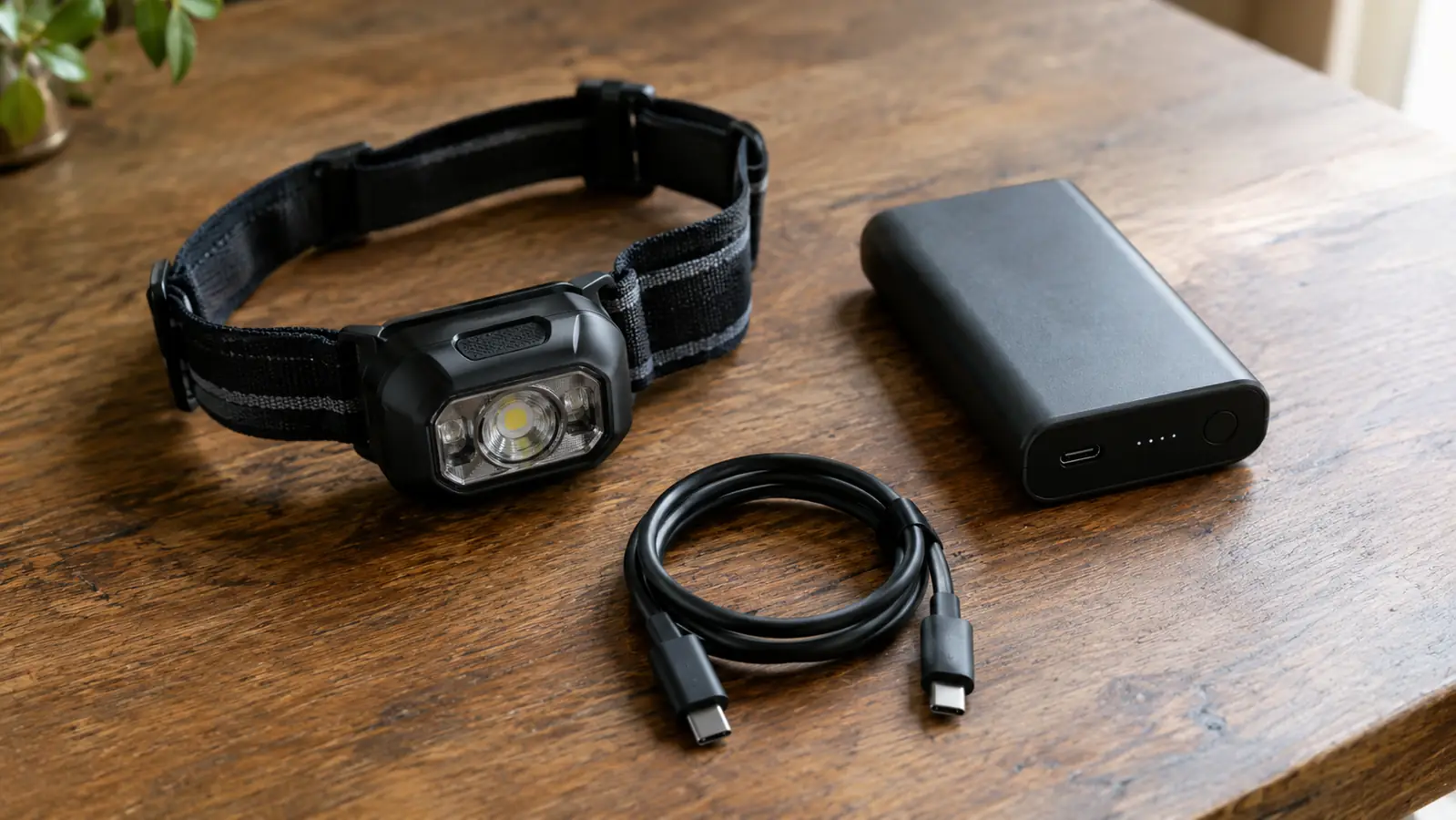
The charging itself is straightforward. A standard USB-C cable works, which means I can charge it from the same cable I use for my phone and my power bank. That is a small thing that makes a big difference in practice. No proprietary charger, no hunting for a special cable. A full charge from empty took about two and a half hours on my desk charger, and the light was usable on low while it charged, which I did not expect and appreciated.
Comfort and Build: What It Feels Like After Two Seasons
At 4.37 ounces, the XPH30R is light enough that I forget I am wearing it. The strap is a simple elastic band with a silicone strip on the inside to keep it from sliding. It does not slip on a sweaty forehead, which is more than I can say for some lights I have used. The angle adjustment is a ratcheting hinge that holds position firmly and has not loosened in two seasons. I have worn it for a full evening of camp work, then kept it on through dinner because taking it off was more effort than leaving it on.
The body is a matte plastic that has survived being dropped on rock, kicked across a gravel driveway, and left in the truck through a week of below-freezing nights. There is a magnetic base on the bottom, which I dismissed as a gimmick until I used it to stick the light to the underside of my truck's hood while changing a battery. It is genuinely useful, and it is one of those features you do not appreciate until you need it. I have also stuck it to the steel post of the carport to light a workbench, and to the side of the fridge during a winter power outage so Joanne could see what she was cooking.
The switch is a single button on top. One press for on, another to cycle through modes, press and hold for off. It is easy to operate with gloves on, which matters in January. The mode memory is a small thing, but it is the kind of detail that separates a light you use from a light you fight with. It remembers the last mode you used, so you do not have to click through three settings to get back to the one you want. That sounds minor until you are standing in the dark with cold hands.
What Nobody Tells You About the Coast XPH30R
The first thing nobody tells you is that the 1200 lumen rating is a peak, not a sustained output. You get a bright burst, then it settles down. That is normal, but it is not how the marketing reads. On the September 2 night hike, I ran it on high for the first ten minutes of the trail, then dropped to medium for the rest of the two-hour loop. The difference was barely noticeable on open ground, and the battery gauge barely moved.
The second thing is the twist focus ring. It is smooth when clean, gritty when dusty, and it needs a rinse now and then. It is not a failure, but it is maintenance. The third thing is the charging flap. It is the weakest part of the design, and it is the part most likely to cause problems if you are not careful. I have not had a failure, but I have caught myself twice reaching for the light with the flap not fully seated.
The fourth thing is that the light does not have a red mode. For someone who does astronomy or wants to preserve night vision, that is a real gap. I have a separate red light for that, but it is one more thing to carry. The fifth thing is that the beam tint is neutral, not warm. It renders pine needles and trail dirt accurately, which I prefer, but if you like a warm, cozy camp light, this is not it.
Pros and Cons
What I Liked
- Twist focus is genuinely useful and smooth when clean
- 1200 lumens is a real, usable peak output
- USB-C charging with a standard cable
- Magnetic base is more useful than it sounds
- Light weight and comfortable for hours
- Strap does not slip on sweaty skin
Where It Falls Short
- Charging port flap is easy to leave slightly ajar
- Twist ring collects grit and needs occasional cleaning
- No red mode for night vision preservation
- Built-in battery cannot be swapped in the field
- Peak output steps down as the battery drains
Who This Is For
This is the light for someone who wants one headlamp that does most things well and does not weigh them down. It is for the person who camps a few times a month, keeps a kit in the car, and wants a light that charges from the same cable as their phone. It is for the person who appreciates a magnetic base and a twist focus that can go from map reading to spotting across a field without changing lights.
It is also for the person who is willing to learn one habit: check the charging flap. If you can do that, the XPH30R will serve you well for years. I have handed it to two other people on night hikes, one a former deputy and one a friend who camps maybe four times a year. Both figured out the twist focus in under a minute without instructions. That tells me the design is intuitive where it counts.
Who Should Skip It
Skip it if you need a red mode for astronomy or military-style night work. Skip it if you spend weeks at a time away from power and need a light that runs on disposable batteries. Skip it if you want a dedicated spot beam with a clean, round hotspot, because the twist focus gives you a compromise, not a specialist's tool.
And skip it if you are the kind of person who will never remember to check that charging flap. The light is tough, but it is not indestructible, and the port is the one place where water can get in. If you are the sort who throws gear in a bag and expects it to survive your worst habits, a light with a fully recessed port or a screw-down cap will serve you better.
The honest bottom line
The Coast XPH30R is not perfect, but it is the light I reach for first. If you can live with twist focus and a flap that needs a thumb check, it will earn its place in your kit. See today's price on Amazon.
Amazon Check Today's Price on Amazon →